Note added 21 June 2021: following the recent discovery that, through all the years I was working with him, Chris Goode was consuming images of child sexual abuse, I'm in the process of writing an update to the below, which details some of the reasons I stopped working with him in 2018. In this 2018 post I acknowledge that I was complicit in some of the harms he caused, for instance by erasing the work of other women who worked with him, fuelling a cult of genius around him, and consistently asking people who criticised his work (particularly the sexually explicit work) to see it softer ways. With so much guilt and shame wrapped up in this sense of complicity it's taking me a long time to look over the past decade and understand how I might have worked or thought differently. Other changes will be made to this blog as I think this through, and I invite trust and understanding that these might take some time to emerge.
Further note added 27 July 2021: that new post is now written and undergoing an extensive rewriting process as it's read and commented on by people who appear in it (that is, other people who worked with Chris in the seven years when I did). It could be up to a month before it's ready to share publicly, but I'm happy to share it privately in the meantime. (Sept 30 update: had to put it aside because it was consuming my whole life and i had commissioned work becoming overdue. Coming back to it soon.)
New note added 14 September 2022 (yes, almost a full year later): what's actually happened is that, since April this year, I've substantially rewritten that text, not least to be more conscientious around whose names and what identifying information are being shared. Until it's absolutely ready for publishing, I'll be rethinking what names appear in this blog. I have repeatedly considered trashing all the writing about Chris's work from this blog - after all, anything I wrote for the Company website was first trashed when the website was attacked by malware, and trashed again when the company closed - but with each iteration of this thought cycle I return to the wise words of Rajni Shah: 'I have a fear that these calls for destruction might be where the work of this moment ends, leading us from one dangerous archetype (the figure of the lone genius) to another (the figure of the villain, who can be eradicated, thus eradicating harm from our community).' The work remains, but with fewer names.
**
In March of this year,
a friend said he'd clicked on my blog to see what I'd been up to and
was startled to find nothing new. It's not like this has ever been a
prolific space, but even so, at that point it had been six months
since I'd published anything, the longest gap since Deliq began. It's
not that I didn't want to write here, I'd just been busy: building a
case study library for the Calouste Gulbenkian Foundation, 80 texts
looking at “next” practice in socially engaged, community and
participatory arts; collaborating with Mary Paterson and Diana Damian
Martin on two platforms for experimental writing and critical
thinking, Something Other and the Department of Feminist Conversations; writing reviews for Exeunt; writing on commission,
including a series of pieces looking at Pivot Dance for the Place;
and then doing a bunch of other stuff like thinking about loneliness
at Manchester Royal Exchange, hosting theatre clubs, leading a
workshop at the Almeida for its young critics, coordinating an
informal writers group. It's quite nice making that list: it reminds
me I'm not drifting as inconsequentially as I feel.
I saw Vs twice that June, both times in unusual circumstances, and had disconcertingly different experiences. The first was on a Saturday, and I had spent the day with one of my oldest friends, celebrating the bat mitzvah of her daughter, who had made a beautiful, delicate speech about what it meant to assume the mantle of womanhood, and to acknowledge and welcome that step in life surrounded by family and friends. With that backdrop, Vs felt like a pulse of longing: it ached at its core for ceremony and ritual in secular life, for rites of passage that might connect men to each other and to the earth, for a social embrace of queerness, for a way to undo the damage of toxic masculinity and reacquaint with the sensuality and grace of young men. The six performers ended the show racing from the back wall of the auditorium to the feet of the audience, and it felt like they could burst through to freedom if only we representatives of society weren't always getting in the way with our conventional attitudes about what men should do and who men should be. The moment it finished I went straight to where Chris was sitting and cried on his shoulder at its sadness and promise and plea.
Blogs shut down all the
time, people move on to other things, but there's something
particular about the story of this blog that makes me want to reflect
on why I'm finally, having thought about it for months, calling it
quits. When it began, in April 2011, I was only just returning to
thinking about theatre after four years of baby-making; in many ways
I was only just returning to thinking at all. I was still working for
the Guardian as a freelance writer on contract, but increasingly
unhappy and wanting to change things. Change my writing. Change my
relationship with theatre: its makers, and its audiences. This blog
was my one banal idea for how to do that. I look back on my early
posts and see how hesitant they are, how embarrassed, no matter how
playful I'm trying to sound. I can also see where the turning points
are, the moments where an outside influence breaks something open for
me. The first is Melanie Wilson's Autobiographer: I'd never written
about someone's work in such an elliptical way before, and loved the
show all the more for what it drew out of me.
The most crucial
outside influence has been Chris Goode. A fortnight after I started
Deliq, he emailed to ask if I would be interested in trying out a
collaboration within the new company he was setting up. We didn't
have a language for what I might be doing at the time, but we built
one from two words, storyteller and bridge: I would be telling the
story of the company back to itself, and building bridges between the
company and its audiences. Later we shaped more official-sounding job
titles that reflected the wider conversation happening around
“embedded” criticism: first I was Critic in Residence, and later
Critical Writer. But these two notions of storyteller and bridge
remained vital.
Until Chris Goode &
Company built its own website, in 2015, everything I wrote within the
company was published here, in my space. It has meant a lot that all
of it has been independent: I've not had to vet the writing, barring
three exceptional circumstances (and even two of those were my choice): when I needed to run the 9 texts
past West Yorkshire Playhouse; when I responded to the reasons given
by Arts Council England for not awarding the company NPO status in
2014; and when I was writing about a heated, uncomfortable moment
during the Rabble R&D that I hadn't witnessed. Even when my CG&Co
work moved to the company website, I carried on writing about Chris's
alt-ensemble, Ponyboy Curtis, here. And so I can't think about Deliq
without thinking about my role in CG&Co. They are entangled. What
follows is a record of unravelling.
*
This is the fourth
version I've written of this
valedictory post (fifth if I count the additional edits). Here are some things I'm resigned to. It's a mess.
It's pulling in several directions at once. It's too long, too
solipsistic, too laborious to read. I don't really know what it's
doing, or who it's for, other than me. It began as an attempt to
explain to myself and Chris why I'm leaving Chris Goode &
Company, but between the second draft and the third I met up with him
and told him in person and forgot half of what I'd intended to say. I
still want it to be a public explanation because yes, I'm leaving
Chris Goode & Company, but I'm haunted by generous friends who
read earlier drafts and pointed out that people stop working together
all the time, move on to other things: why is a public announcement
necessary?
It comes down to that
job title: how many other theatre companies do you know with a critic
in residence? I've spent seven years attempting to stand back and
assess what I'm doing – be an outside eye to my own outside eye, if
you like – and feel some responsibility to continue. Such navel-gazing has felt
requisite, because I'm constantly aware of the ways in which I work
in opposition to the wider culture, which has a marrow-deep suspicion
of people being paid to write about theatre by those who make it. The
writing is seen as biased, skewed, untrustworthy by comparison with
“objective” journalism (pause while I chase after my eyes which
are rolling away). It's seen as marketing. Maybe I'm being elitist in
being furious about that – marketing can be a creative job after
all; or maybe I just recognise that people doing PR get paid far more
than I've ever seen or wanted for my company writing.
Some of the work I've
done for Chris Goode & Co has been paid; since April 2018, CG&Co
has been a National Portfolio Organisation, which even gives me a
salary (and makes leaving now seem pretty incomprehensible). But I've
never worked with Chris for the money: I said yes to his invitation
because I'm a fan, and most of what I've done has been for love. I
still remember the first time I encountered him, in a cramped and overheated Pleasance venue at the Edinburgh festival in 2002 [later correction! 2003], performing Kiss of
Life: to be honest, that's how the work felt to me, life-giving,
oxygen-gifting, because I'd never seen anything like it, a shy man
telling a love story about two lost souls and the argon in the air
each one breaths out, breaths in, shared with the strangers of the
world. I've loved Chris's work ever since for its queerness, its
delicacy, its anti-capitalist politics, its romance, its empathy with
outsiders, the rejected of society, those in pain, its desire to open
space for those outsiders within theatre. Somewhere along the line of
the company I stopped saying I love his work and started saying I
love him. Which is part of what's made writing this so difficult.
*
Although we started
working together in 2011, it took until 2014 for me to find
confidence in what I might do as part of CG&Co. And it might not
have happened but for the Guardian firing me. (OK, deciding not to
renew my freelance contract. Same difference.) I wrote about that
here in January 2014; seeking what positives I could find for this
calamitous, self-fracturing event, I suggested it might be “the
push I need to stop sitting tentatively on the outside of Chris Goode
& Company, and properly embrace the extraordinary opportunity he
gives me”. And it was. In the next few weeks I finished writing about God/Head, a process that had taken me two years, presenting it
as an experiment in what Chris dubbed polyvocality: multiple voices
talking about the show, each of the three parts of the writing coming
at it from a different angle, echoing how the show itself told a
single story in multivalent ways. The advent of the CG&Co
website in 2015 gave me space to expand that polyvocal approach
across different kinds of non-linear and cross-disciplinary
storytelling. I played with journals to document Riot Act (2015);
built an online magazine around Weaklings (also 2015), featuring
playlists, ephemera, writing by and interviews with the making team,
and more; did the same but different for Every One (2016), this time
including interviews with makers unconnected to the company who had
also made work that put them face-to-face with death, a video
compendium of versions of the song Oh Death, and a collection of
found texts on the subject of ironing – ludicrously tangential, but such a joy to pull together. In 2017 I went old school and made a
40-page fanzine for Jubilee, carting 500 copies up to Manchester in
the family suitcase. It's painful making this list because the
website got attacked by malware around autumn 2016 and no one has
been able to fix it. Generally I'm hesitant to praise myself, but I
feel stupidly fucking proud of the work I've made alongside Chris and
now so much of it is dead and invisible. I can't even link to it here. It's galling.
For every thing I did
within the company, there were always two or three things I wasn't
getting round to doing. I still haven't written about the Witch of
Edmonton R&D week in the National Studio (2013), even though
Chris's “remix” of the text, an open invitation to his
collaborators simultaneously to perform, fuck with and comment on the
original remains one of the most electrifying things I've seen him
make. I never wrote a reflection of all the different Open House
weeks. I mentioned, but never went into, the difficulties of the
Weaklings rehearsal process, and didn't write about the work as
performed in Warwick Arts Centre. These and other failures were an
ongoing frustration. But none of them unsettled me as much as not
writing about the last show of Ponyboy Curtis, in June 2017.
*
Just as Ponyboy was the
place in which Chris could take a radically different approach to
making, writing about Ponyboy was where I leaned into poetry, knowing
that I haven't the verbal or imaginative dexterity to be other than a
terrible poet, knowing that Deliq would shelter me anyway. My
relationship with Ponyboy was very different to that with CG&Co:
I was paid to attend the first R&D week in December 2014 and
write about it, paid again to make a Ponyboy zine in June 2017, but
in between went to no rehearsals and often bought my own tickets to
see the performances. But here I am talking about money again, as
though that validates anything.
At the time Ponyboy
started, I was writing an essay for Duska Radosavljevic's book
Theatre Criticism: Changing Landscapes about working with Chris. It
took me a year. Among other things, I wanted to make the argument
that being a fan does not negate criticality, contradicting an
assertion made in 1992 by Irving Wardle, in his own book called
Theatre Criticism, that the critic who enters the rehearsal room also
enters “the circle of hypnosis”. Paying attention to the process
of making, rather than the product shown on press night, Wardle
insisted:
“changes perception
of the work. As an observer, you become the company's mascot. You
make friends. You sympathise with their difficulties. … Having made
the journey with them, you are only conscious of what they have
achieved; and you want what they want – unconditional approval.”
It still annoys me,
this piece of text. This is how I batted against it in the essay for
Duska: “As a fan, I wanted, in Wardle's phrase, 'unconditional
approval' for and from Chris. The more rounded picture of how he
makes theatre that I've since gained through access to his rehearsal
room hasn't made this biased perspective more sympathetic but more
exacting. I am scrupulously honest in declaring the moments watching
his work when I feel bored, confused or disappointed: but I am also
meticulous in taking the time to understand why I might be responding
in this way.”
I'd put it differently
these days – maybe instead of bored, confused or disappointed I'd
say challenged, provoked, troubled – but honesty and meticulous
care are still the principles by which I'm trying to live. I try to
question everything, not least myself. I don't think I'll ever do it
well enough.
*
Inside the Ponyboy zine
is a juvenile poem by me about Walk Pause Walk, a one-night-only
performance at Camden People's Theatre in May 2017. It was Ponyboy's
most sexually explicit show to date, and most physically aggressive,
lighting bright over the men groping and probing each other inches
from their audience. I struggled with it, and did say that in the
zine, in a wonky kind of way – but not here on Deliq, and not as
clearly or astutely as Ben Kulvichit on his blog Smaller Temples, a
review that queried how Chris uses his “position of relative
authority” in choosing which bodies to present on stage, and
whether the “romantic, queer utopia” created by those bodies “is
quite as utopian a model as it wants to be”. Maybe my own choice to
hide in the zine was fine, but it felt weird. And then came Vs.


I saw Vs twice that June, both times in unusual circumstances, and had disconcertingly different experiences. The first was on a Saturday, and I had spent the day with one of my oldest friends, celebrating the bat mitzvah of her daughter, who had made a beautiful, delicate speech about what it meant to assume the mantle of womanhood, and to acknowledge and welcome that step in life surrounded by family and friends. With that backdrop, Vs felt like a pulse of longing: it ached at its core for ceremony and ritual in secular life, for rites of passage that might connect men to each other and to the earth, for a social embrace of queerness, for a way to undo the damage of toxic masculinity and reacquaint with the sensuality and grace of young men. The six performers ended the show racing from the back wall of the auditorium to the feet of the audience, and it felt like they could burst through to freedom if only we representatives of society weren't always getting in the way with our conventional attitudes about what men should do and who men should be. The moment it finished I went straight to where Chris was sitting and cried on his shoulder at its sadness and promise and plea.
Six days later I saw Vs
again and the moment it finished I went straight to where Chris was
sitting and told him I'd never wanted to punch anyone more in my
life. I was livid and told him that too. For the most part this
performance of Vs, at once a response to and remix of Stravinsky's
Rite of Spring, was passing similar to my first, not least in the final
section. This starts with the selection of a single Ponyboy –
through the child's play trick of spinning a bottle – to be the
centre of the sacrifice; he is sanctified in a shower of sexual
attention; he spins himself dizzy in the centre of the circle; and
then all of them join together in their Olympian race from one end of
the stage to the other. But this night, the “chosen” Ponyboy span
to a point beyond self-control, taking a cyclone hurl out of the
circle and smashing himself against one of the Yard's architectural
pillars. It was horrible to watch because it felt gratuitous, an
endurance test proving nothing, benefitting no one.
For me there was an
additional, acute context: that afternoon, walking my kids home from
school, I'd seen a small group of people gathered on the pavement,
disquiet crackling around them. As I passed I asked one of the women
if everything was OK. She gestured towards another woman at the
centre of the group, standing beside a pushchair, and said: she's
just had a miscarriage. I looked at this stranger's legs and saw
streaks of blood tracing vein lines down her limbs, her hand reaching
down with ragged tissue in a futile attempt to wipe it away. Oh god,
I said, I'm so sorry. And walked on, thinking there was nothing I
could do. It wasn't until I was almost home I remembered that there
was water in my bag that I could have given her to help wash the
blood away. For days after, walking the same route, the kids and I
would see the blood stains on the pavement, slowly turning from
crimson to brown, and I realised that anyone who didn't know the
story of the woman might assume this was the mark of a stabbing or a
fight, gratuitous acts by men with nothing better to prove.
With that backdrop, Vs
felt less a plea for a different kind of masculinity than an
expression of everything competitive, demanding, swaggering,
bellicose and empowered in the masculinity lauded by patriarchy. It
became telling that this was the first Ponyboy show I'd seen without
a trans male performer, and was the first time I really noticed the
whiteness of the group – which is ironic, because it was the first
performance to include a man with noticeably darker skin. Vs was also
the first time I thought about Ponyboy as a project romantically
enthralled with a kind of ancient Greek notion of masculinity, the
masculinity of heroism and honour and homoeroticism. Given that I'd
been doing a lot of thinking over the previous year about the ways in
which Ancient Greece might have gifted the English-speaking world not
only the words for democracy, misogyny, patriarchy and xenophobia but
a blueprint for their practices of inequality, that was an
uncomfortable connection to be contemplating.
*
Not writing about Vs
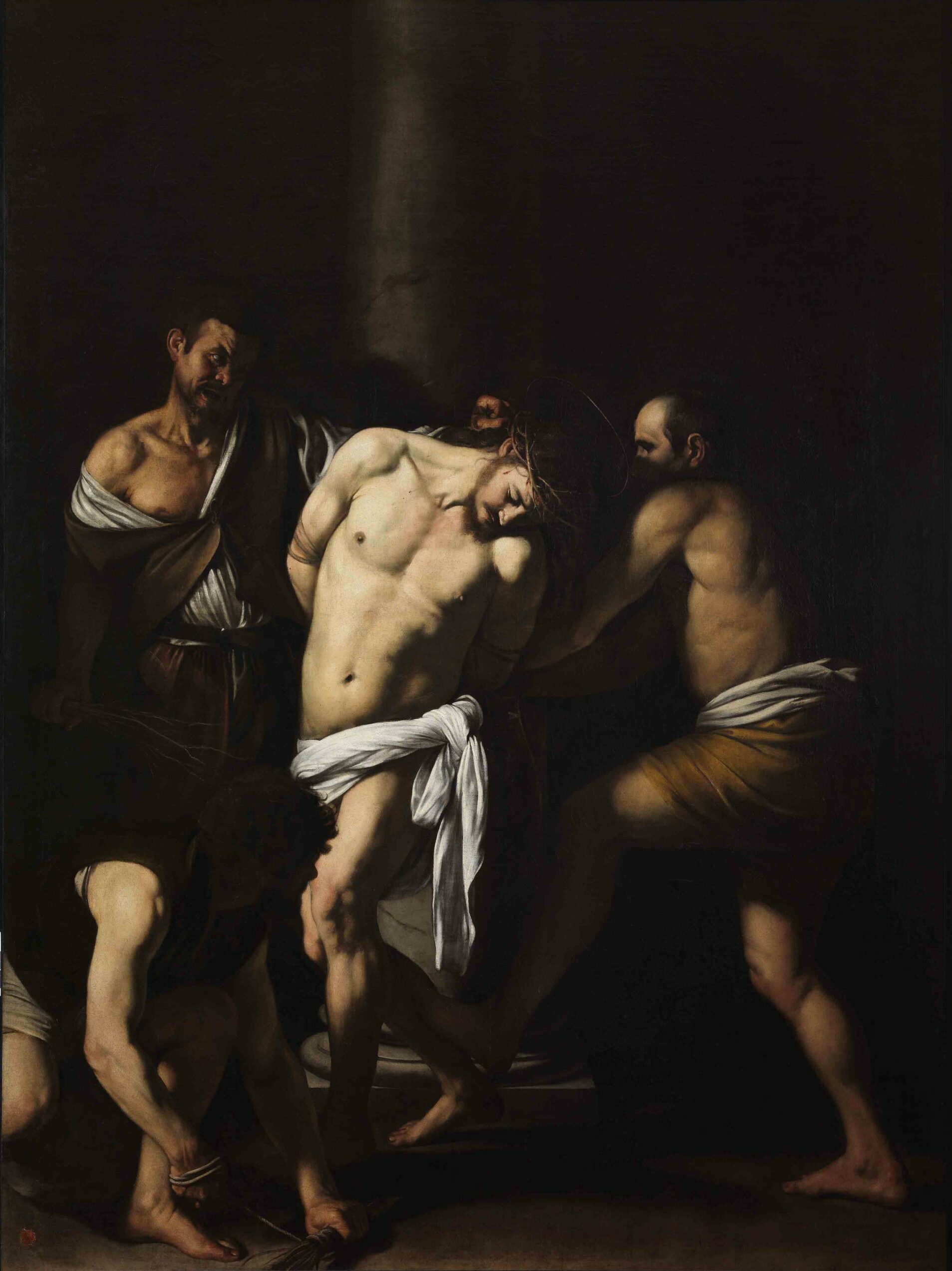
immediately was fine: it was summer, and Deliq has long gifted me time and space to think and absorb other resonances that might take me beyond the limits of my own mind. In August I was on holiday in Naples and
dragged the family up to Capodimonte, where Caravaggio's The
Flagellation of Christ lives at the end of a tantalising corridor,
alone in a darkened room. I love Caravaggio and this one is
mesmerising: Christ's body is curved and luminous and behind him
stands a white pillar, symbol of his rectitude; the men who surround
him are swarthier, faces creased with anger and muscles straining
with the effort of binding him. The effort is unnecessary given
Christ's meekness, and so it's clear that, beneath the fury, they're
taking a pleasure in this act of dominance and punishment. There is
pleasure too in the paint itself, in the folds of the fabric, the
dirt encrusted in the feet, the dips of the flesh outlining Christ's
muscles and the skeleton beneath the effulgent skin, collarbone a cradle for desiring fingers. After maybe 20 minutes
of devoutly scanning every inch of paint I noticed something:
barely visible between the white sheet gathered around Christ's
pelvis and the shadowed tousled hair of the man bending down to tie a
rope around his ankles, there is a glimpse of Christ's cock.
Violence. Sacrifice. Homoeroticism. A note for when I came to write
about Vs.
In November I travelled
to Warwick Arts Centre to see Ben Kulvichit's production of Speed
Death of the Radiant Child, a play by Chris I'd neither seen nor
read. One of the characters is a lecturer in art history and almost
halfway into the play she starts to talk about another painting by
Caravaggio, The Incredulity of St Thomas, seeing: “an abyss of
sexuality here”, with “Caravaggio completely lost in this
homoerotic moment”. What does it say about painting, she asks, if
Christ's appearance isn't enough to inspire belief, if “only an
encounter with the body” will do. What does it say about theatre, I
wondered, if only “getting inside the body” will do. Another note
for when I came to write about Vs.
April 2018, I read an
article in the Guardian by Tim Winton, extolling the “lovely.
Graceful. Dreamy. Vulnerable” qualities “shamed out of” young
men when they're called to “pull on the uniform of misogyny and
join the Shithead Army that enforces and polices sexism”. Winton
also spoke of ritual, and how: “In the absence of explicit,
widely-shared and enriching rites of passage, young men in particular
are forced to make themselves up as they go along. Which usually
means they put themselves together from spare parts, and the stuff
closest to hand tends to be cheap and defective.” That, I thought,
is the romance of Vs: it creates an enriching rite of passage
unavailable to young men anywhere else. In the same month, Elizabeth
Smart's The Assumption of the Rogues & Rascals crooned to me this
description of a dream: “Outside in the beech woods, when the
leaves were small and calligraphic, loped a troupe of half-grown boys
like deer, with bodies the colour of sunlight on bracken, and black
eyes, and thick straight hair. They were light-footed, swift, and
evasive, but when a soft moon hung on the edge of the horizon, they
came stampeding towards the stone castle as if they were all hooved.
… They came. With savage grace and royal silence, careering with a
cruel panther purpose. Oh their wild terrible untouchable beauty!”
There too, a romance, an idealism.
So many notes gathered
to feed into the Ponyboy writing, but when June 2018 rolled around
and I still hadn't written a word, I started to wonder what was
stopping me. Worse: I started to wonder if I were still being
“scrupulously honest in declaring the moments watching [Chris's]
work when I feel bored, confused or disappointed”, challenged,
provoked, troubled, or if I could still trust this to be true.
*
It took two years to
write about God/Head; five years to write about a Berger afternoon Chris curated at Somerset House. I'm slow with this stuff sometimes;
a year not writing about Vs wasn't that big a deal. But it felt like
one because of everything else happening. By the end of 2017 Ponyboy
had disbanded; I was too peripheral to tell a story so involved. In spring 2018 Chris Goode & Company began working
with an external consultant to think
particularly about how Ponyboy operated, and by extension about how
Chris works as a director; their report will become the basis
of a new CG&Co code of conduct. With NPO approaching I had set
out on a research project of my own, to figure out what I was and
wasn't doing effectively within the Company, and what I might need to
improve on. All of these things have their parts to play in me
deciding to leave the Company but fucking hell are those parts
complex. Even trying to explain the simple bits is hard enough.
I started writing this post on September 19th; it's taken four drafts and multiple revisions because it's an incomplete representation of irresolution. Behind seeming decision
is an unresolved difficulty: I am ready to leave, and also
heartbroken by the very idea of leaving. What I do have is a kind of mantra, three clear and straightforward reasons for moving
on. One is a realisation about myself, and what I have and haven't
been writing, drawing attention to, perhaps even noticing or paying attention to, while part of the company. One is
a realisation about Chris, and what it means to be writing about an
artist widely hailed a genius. And one is to do with the widening scope of other
relationships I've built as a fan of performance in general. Anything
beyond this mantra dissolves into confusion any time I approach
it.
*
There's a way in which
this bit of the story begins in January 2017: in the midst of the NPO
application process, I was beset by splintering confidence and an
anxiety that Chris and I might be pulling in different directions. I
thought about leaving, but the thought drifted. So really this starts in November 2017 – when, ironically, Chris and I
were having some of our most complex, trusting, supportive
conversations to date, inspired by the fraught process of staging
Jubilee at the Royal Exchange in Manchester.
There are ways in which
this work's difficulties were the same as might happen in any
rehearsal and making process: the scale and profile of the event was
unnerving; most of the cast were away from home; a lot of the team
hadn't worked with Chris before. Some were specific to Jubilee
itself: some of the cast were more experienced in cabaret than
main-house theatre settings; there was a responsibility to the Derek
Jarman estate to honour the original film. And something specific to
the moment itself was the unfolding backdrop of #metoo revelations:
particularly stressful given that Jubilee involved a fair bit of
naked and sexually explicit work.
As part of our
conversations, I told Chris I had noticed a pattern in how he runs a
rehearsal room. He will begin by emphasising that he's not a person
of power; that this is a non-hierarchical space in which everyone is
equally valued, equally heard, and making together, not least making
mutual care. There will be an initial period of discussion –
glorious, discursive, intense, difficult sometimes, digging deep into
the ideas or the text that he's brought into the room. And then, as
pressure rises, he will suddenly, dizzingly, pull rank and become The
Director, site of authority.
I'm aware that dynamic
is pretty typical in theatre. And it doesn't convey how Chris has
made a different kind of listening and mutual endeavour possible: for
that, it's worth reading a blog post by Jubilee's sound designer Tim Atack meditating on power in the making process, where Chris is cited as an example of good,
inspiring practice, for shaping “a working process that listened as
much as it spoke” and expressly giving everyone in the room
“permissions to speak up about the tricky or the urgent or the
suppressed stuff”. Ideally you'd also read an essay comparing the
different approaches to generous shared making practised by Chris
when making the 2012 show Monkey Bars, and by the more chaotic group using the principles of Open
Space that I was part of in another rehearsal room at the same
time, but that's another thing I never wrote.
I've mentioned this
dynamic, despite its flaws as an observation, because it was the
first time I'd actually understood it as a pattern, not an odd detail
I was noticing and filing away with many others, uncertain what to do
with it. As Jubilee finished, the feeling continued to niggle that I
had been overlooking things in Chris' rehearsal rooms, both in terms
of not seeing them and not writing about them. To assuage it, in
December 2017 I set up a series of conversations with some of his
long-term collaborators. Through those I discovered:
I hadn't written about
any of the directorial work Wendy Hubbard did on Men in the Cities,
instead writing about it as a solo show.
I had named all four of
the women who worked with Chris as associate directors on Wanted –
Kirsty Housley, Evie Manning, Pauline Mayers, Jennifer Tang – but I
hadn't given any real consideration to what they might have
contributed to it, instead thinking of it in terms of Chris' previous
work, his thinking, his politics.
I hadn't written about
the ways in which Angela Clerkin played such a positive pastoral role
with the cast of Monkey Bars.
I think I did write
retrospectively about the incredibly difficult theatre club I held
for Men in the Cities in Cambridge with a room full of women from the
university's feminist societies, whom I'd personally invited, but I
didn't write about the ways in which lighting designer Katharine
Williams struggled with that work, which might have helped me to
anticipate those women's antipathy to the play, their refusal to see
it in the feminist terms I was presenting to them.
In fact, I've written
very little about the contributions Katharine Williams makes as
lighting designer, or Naomi Dawson makes as designer.
In not writing about
the Witch of Edmonton Open House week, I'd left undocumented the
moment – still haunting – when Kelda Holmes walked out, leaving
on the wall a letter explaining that the big, busy room had
“reignited feelings of exclusion and anger”, not least through
“men using their power misogyny / interests to push away strong/
needy women”; and then the other moment, no less haunting, on the
final day, when she pulled off her shirt mid-performance to reveal
her breasts, as both answer and challenge to those men.
There's a lot of women
in this list of things I haven't written about when writing about
Chris. And here's something I realised through compulsive rereadings
of the drafts of this post: the reason I'm so insistent on including
Vs is nothing to do with Ponyboy or that work. I have pages of notes
on it that will mostly remain unpublished. What felt important was
telling the stories of those two women: the daughter announcing her
womanhood at her bat mitzvah, the stranger who miscarried on the
street. It's their experiences I want to be remembered.


*
In one of the bits of
Caitlin Moran's book How to Be a Woman that most irritate me, she
insists that “even the most ardent feminist … can't conceal that
women have basically done fuck all for the last 100,000 years. …
Let's stop exhaustingly pretending that there is a parallel history
of women being victorious and creative, on an equal with men, that's
just been comprehensively covered up by The Man. There isn't.” It
irritates me because I think her intent is satirical but it fails,
coming across instead as untempered internalised misogyny. And even
if it is satirical, it's still typical of how women's work and
creativity haven't just been covered up by The Man, or men.
Patriarchal constructs
might not prevent women (in the UK) having access to education and
the means of communication any more, but its insidious effects are
such that women don't necessarily use these things to support each
other. When talking to Kirsty Housley about how I had failed really
to think about her work on Wanted, she told me how difficult it has
been to be credited and recognised as co-director of Simon McBurney's
The Encounter. How, whenever Javaad Alipoor's The Believers Are But
Brothers was promoted or written about, his dramaturg Chris Thorpe
would be named but not her as co-director. The prominence of male
artists, male thinking, male work, is pervasive and it's a culture
made and maintained by everyone who contributes to it. Theatre is no
exception to this. And nor am I.
This is what I was
thinking about in May 2018 when I found this passage in an essay by
Megan Garber called David Foster Wallace and the Dangerous Romance of Male Genius:
“Here is the
etymology the Oxford English Dictionary provides for the word genius,
imported to English straight from the Latin: 'male spirit of a
family, existing in the head of the family and subsequently in the
divine or spiritual part of each individual, personification of a
person’s natural appetites, spirit or personality of an emperor
regarded as an object of worship, spirit of a place, spirit of a
corporation, (in literature) talent, inspiration, person endowed with
talent, also demon or spiritual being in general.'
There’s more, but
there’s already so much: genius, by definition a male condition.
Genius, a male condition that inflects its maleness on the individual
soul. Genius, an object of worship. ... [M]illennia later, the biases
of the language remain with us, tugging at the edges. Genius itself,
the way we typically conceive of it, remains infused with the male
gaze, or perhaps more aptly, the male haze: It is gendered by
implication. It is a designation reserved, almost exclusively, for
men.”
My essay for Duska's
book begins with a quote from the Guardian in which Chris is
described as “one of the geniuses of British theatre”. This
culture of genius is one I am complicit in as writer and storyteller.
If I'm going to contribute to shaping a different culture, and I'd like to, I need to
reconsider who I'm writing about, what stories I'm helping to tell.
*
I've been thinking a
lot about complicity over the past year, the ways in which theatre,
as an industry, generates secrecy and gossip. Of course I have: it's
been the year in which #metoo, a movement started in 2006 by Tarana Burke to support people to speak out about sexual abuse and assault
and in doing so reveal how pervasive it is, finally reached UK
theatre. I've obsessed over an interview with Vicky Featherstone,
published at the beginning of November 2017, in particular this
paragraph:
“The reason I’m so
angry is I’m so shocked that we’d got to this point and we’d
all accepted it. We all knew about it! We. All. Knew. … I knew that
pretty much every single woman I know had suffered sexual harassment
in her life. I knew that, and I’d just accepted that. I’m
hardwired to accept it. I’m a feminist, and when I talk about it,
it shocks me. But I had literally accepted it, like I accept that we
have a class system. I’d accepted it like I accept that there are
homeless people. And that’s just bizarre – but it’s what we’ve
done. And then suddenly someone speaks out, and you start to think,
why are we as a society accepting of this situation?”
I have this impulse
inside of me to push this away, to ask who the “we” are, and what
exactly they knew, and how many people they shared it with, and how
many other people fell foul of shitty behaviour because they weren't
in the right circles to hear the warning. Two obvious problems with
that: firstly, to do so is to ignore Vicky's real point, which is
that “this situation” isn't personal but systemic. Secondly, to
do so exposes a desire to evade complicity. But I am complicit. I've
lost count of the times that people have confided in me about how
they've been mistreated by artistic directors, given bad deals, bad
contracts, ignored, exploited, underpaid – all the banal sludge
reality of working in theatre – and I've kept that information
tight rather than expose anyone, because like everyone else who works
in theatre I'm scared that if I tell too much truth it will
jeopardise my chance of future work, but also because those people
specifically asked me to keep silent.
There's a blog post published in April 2012 by Daniel Bye that I hold close and still
recommend frequently, for this chunk in particular:
“The
[making/rehearsal] process is constructed of a complex web of
assumptions about the ways people should and do interact with each
other, how best they work under pressure, how they can be enabled to
produce their best work. In this respect a rehearsal process is no
different from any other human interaction geared towards a common
end. And it's amazing to me how many processes work according to
assumptions radically contrary to those the work is attempting to
encode. How much work espousing collectivist left-wing politics is
made under (benign or otherwise) dictatorships? Good critical writing
about process could observe inconsistencies like this in a way
artists might not – could observe assumptions and conventions so
internalised we're not even quite aware of them.”
I keep recommending it
because I think Dan was really on to something. I think Tim's long
piece about power is a phenomenal example of what he was describing.
But also, Dan was talking about “embedded criticism”. I don't
think that's what I've been writing, it's just the label that got
slapped on it. Sometimes I've thought I should be writing it, should
be aiming for that level of transparency. Mostly I haven't wanted to:
I've wanted to pursue, within the meagre confines of my ability, a more selfishly creative line.
*
Between drafts three
and four, a writer for the Canadian magazine alt.theatre interviewed
me via email for an article she's writing on “embedded”
criticism. Here's some of what I told her:
“so, before emailing
you i emailed a friend, arguing for the umpteenth time against my
work being defined by the word embedded. i feel really bad about the
email, because i think i come across as a raging egotist. but i also
sent her a link to this article -
https://www.theguardian.com/stage/2006/jan/25/theatre1 - it's not one
i wrote, it's one i commissioned while working for the Guardian
newspaper. i asked the writer to spend a really serious amount of
time with the theatre company, to get a sense of how they make work.
she was, effectively, embedded. but that's not how i would have
described it. the word embedded is really easy, people latched on to
it quickly, and i totally understand why. it's a word i sort of hold
at arm's length when i use it, and it's part of that sense of gift
that with Chris i was never embedded, i was part of the company,
maybe not right at first, but pretty soon after. the job titles i had
there were, first, critic-in-residence, and second, critical writer.
i much MUCH prefer those as terms, esp the first one - cos everyone
understands the term writer-in-residence, right? so it's just as
clear in its description of the work as embedded, and less of a joke
thing”
The way I think about
criticism – not just embedded, all of it – has changed profoundly
through working with Chris, affecting how I want to do it, and how I
want to talk about it. I don't want to see
the performance as a product that consumers need to be attracted to
or warned away from. Nor do I want to go into rehearsal rooms and
write diaries: anyone can do that. I wanted to give proper
attention to the obvious fact that the number of people who can see
the work of CG&Co in person is limited by time and geography,
which requires rethinking how people might instead interact with it
online. Sure, we could post up video footage of a performance: but
again, anyone can do that. What interested me more was the idea of
creating “parallel performances”, using the same materials and
themes and ideas as the company to make work specific to a digital
space that could be accessed at any time, carrying with it some
flavour of the live performance but in no way seeking to represent or
stand in for it. (For an exponentially more inventive, smart and
technologically dazzling variation on the same idea see Sarah Grochala's work with Headlong: to be honest I can't really look at it
because it makes me want to cry at how humdrum mine is by
comparison.)
Even when I was/am more
straightforwardly reviewing a performance (writing here and, also
from 2015, on Exeunt), I started to think about how I might honour
the form of the work itself: if not meet the creativity of the makers, at least reach towards it.
In this I was definitely influenced by the critical practice of Mary Paterson, now a collaborator, who doesn't describe herself as a
critic but an artist. I'm no more artist than poet. But
I do think of criticism as a process, part of the bigger process of
making theatre.
*
To me, there isn't much
relationship between any of that and the term “embedded criticism”
that emerged in April 2012 in a blog post by Andrew Haydon. This was
published several months after I'd started working with Chris, but
around the same time I started collaborating with Jake Orr, now a
producer, on a proposition we called Dialogue, wanting to explore and
advocate for new ways of thinking about the relationships between
people who make, watch and write about theatre. Jake and I met at a
Devoted and Disgruntled session in January 2012 where I talked quite
a lot about working with Chris, and where Jamie Wood asked me a
shrewd question: given that Chris writes so exquisitely about his own
practice (he hadn't yet called his own blog quits), what could I
bring? The question was so piquant I inserted it into the first draft
of the essay for Duska's Theatre Criticism book, answering like this:
“I see through other eyes, address his work through a different
sensibility.”
With the accumulation
of time, I began to wonder about that different sensibility: not just
because of being a fan, not just because of love, but because the way
Chris articulated his politics was instrumental in helping me to
articulate mine. I don't just mean ideological politics, I mean a
kind of emotional politics: I think about the number of times I've
(mis)quoted the idea of “putting your armour down”, phrased by Utah
Phillips but introduced to me by Chris on his blog.
With the accumulation
of more time, I began to wonder where our edges were, if I knew any
more where Chris ends and I begin. I was feeling this already in
February 2016 when he published his book The Forest and the Field and
gave me a copy. I didn't read it and still haven't, because somewhere
deep inside I've known I need to preserve some space in my head where
I might think about his work separate from how he thinks about it.
The reflection process I began in December 2017 made me wonder if
even that tactic had been successful. As well as thinking about all
the things I hadn't written, I thought about all the conversations
I'd had since February 2016 – particularly about Ponyboy's work –
in which I'd encouraged people to see things a different way:
arguably, Chris's way. I keep going back to that irksome phrase of
Irving Wardle's, the “circle of hypnosis”, and wondering if I'd
entered it imperceptibly. I want to think I've always maintained
mental independence from Chris. But maybe I need physical
independence to be sure.
Does this mean
“embedded” criticism doesn't work? How can we possibly know?
Every process is different, every writer-maker relationship is
different. Chris and I are just two people: we're not and can't be
representatives of an entire industry, especially an industry as
lacking in transparency and, let's face it, honesty as theatre. We've
followed one path: there are still so many others not walked. All
of them might help to build different relationships between people
who make, watch and write about theatre. I hope I get a chance to
travel some of them too.
*
Deliq began with a
question: what kind of stories do I want to tell? And how do I want
to tell them? As I draw Deliq to a close, those questions are as
alive and pressing as ever. This has been a place of transition for
me, a horizon I've walked towards, which moves a step away with every
step I take towards it (thank you Rebecca Solnit for the image). But
right now Deliq feels like part of an old world: a landscape I've
reached the edge of, far from the horizon where sky meets sea.
Between drafts three
and four I realised another thing. I started writing about theatre in
1997, because I unexpectedly won the Harold Hobson student drama
critic award at the National Student Drama Festival and I was
floundering post-graduation and this seemed like a thing I could do.
I watched theatre intensively for the next seven years, learning,
learning, learning, because I came into this knowing fuck all. In
2004 I burned out. I had nothing left to give to theatre and felt it
had nothing – no truth, no honest feeling – to give me. So I
pretty much stopped watching it, and then came the babies. In 2011 I
started Deliq, because I was falling back in love with theatre and
didn't have anywhere to write about it. If that's three seven-year
cycles – and I have only the faintest inkling of how important a role the number seven
plays in spirituality and psychology – then another is due to
begin.
So here's the landscape
as I glimpse it on that further shore, across the channel of no more
CG&Co or Deliq. Between spring 2017 and summer 2018 I wrote 80 case studies – it could easily be more – for the Calouste
Gulbenkian Foundation, looking at “next” practice in socially
engaged, participatory and community arts, across disciplines and the
world. That research and writing has changed me. It has expanded my
imagination of what I could do: particularly writing about Foundry Theatre in New York, a company that describes so precisely what I
hoped Dialogue might grow into I've wanted to cry that Jake and I gave up so
soon (although the name is still alive in the Theatre Clubs I'm now
co-hosting with Rhiannon Armstrong). But also, it has reminded me of
the responsibility of storytelling. Time and again the people I
interviewed told me that the thing they struggle with most, after
funding of course, is storytelling: dismantling a culture that sees
community art (which is often also grassroots art, and
non-professional art) as less important, lesser quality, by really
shouting about how transformational this work is. That feels like a
useful thing that I could do in the world, helping to tell such
stories. And I've started: in a long essay about Joshua Sofaer's work in Bransholme, Hull, to be published in a book about him next year;
in another long essay I should have been writing while interminably rewriting this fourth draft, looking at art and
creativity in communities gifted £1m of Lottery money; and in some
work I'll be doing with Brighton People's Theatre.
In 2014 I started
collaborating with Mary Paterson, who is amazing, fiercely
intelligent, and endlessly inspiring, on Something Other. That began
as an experiment in how live artists, writers and creative
technologists might work together, but has gradually changed shape to
become a kind of literary journal galvanised by live performance.
Later I joined another collaboration between Mary and Diana Damian
Martin which we call The Department of Feminist Conversations, which
I like to describe as inter-related projects that think politically
about performance and performatively about politics. Working together
is a struggle: all three of us have other jobs and parenting/caring
responsibilities; at our best we give time according to our ability, take time
according to our need. We're trying to model collectively a different
mode of collaboration: not working separately alongside each other,
as Chris and I did, but working together in an ongoing negotiation,
making decisions by consensus, instead of unilaterally. It's hard –
difference always is – and I'm not sure I'm capable of it, of really letting go of autonomy and individualism, much as I know it's important to learn.
Some of the writing
about theatre now happens within SO and DFC, some of it for Exeunt, and there's a new passion project on the scene: Criticism & Love, a series of fortnightly essays through which Andy Field and I
are drawing a partial map of the performance scene as we see it. But
there's been another major shift this year: I'm not just writing
about performance now but taking a small part in making it,
progressing from working as dramaturg on three shows over the course
of two years, to being the dramaturg on three shows simultaneously.
It's set me thinking about what the difference might be between the
role of critical writer and the role of dramaturg: both require you
to stand a little outside, to be rigorous, to ask questions, to think
about the audience experience – but critical writer requires you to
remain outside of the work; as dramaturg you take more responsibility
for the work itself. It's fucking exciting, a whole different level
of creative engagement with theatre for me, and one I hope to
continue.
*
A friend who read the
second draft of this text asked a judicious question: why can't I do
all these things with Chris? Write more about the women he works
with, stop relating to him as a genius, think differently about
collaboration, engage in dramaturgy? Whenever I think about that, a snake
of a thought will come hissing at me. In November 2017, someone who
has worked with Chris, and whom I've written about (favourably I
thought, although they disagreed), named me on Facebook as someone
who works with powerful people because they “think [that] can
advance their careers”. Which I recognise as the time-honoured fate of women who work in the shadow of great
and genius men.
I've acknowledged
several times in this post how working with Chris changed things for
me. Another change that has happened in that time is that I've
learned to acknowledge my privilege, the privilege that got me into
journalism which got me into the arts world. All the work I've done
since the Guardian fired me, but even before that, all the writing
for this blog, everything for Exeunt, all the creative thinking, has
been possible because my husband pays our bills. I might have started
life a working-class second-generation immigrant but I have white
skin and my mother educated me to the hilt in a bid to make me
middle-class. She was the person who worked for my privilege. To be
sure, I joined the Guardian in an era of discrimination that hasn't
ended, just changed shape, at a time – in 1999 – when the arts
desk was embarassed by how few of its pop critics were women and used
positive discrimination to find some. That doesn't erase the fact
that I have plenty of unearned status.
And where has it gotten
me? In the three years after being fired I paid exactly £100 tax:
that's how little money I earned. (It's only because of Gulbenkian
that the 2017-18 accounts are any different.) A lot of the work I've
done online has been lost to website updates; it's all disposable
anyway. When new theatre writers come through who – be warned, I'm
going to be obnoxious here – I'm pretty sure have been at least
partially influenced by the way I talk and write about theatre
criticism, they're described as the new Lyn Gardners. I'm not saying
that to slam Lyn: she has been and continues to be extraordinarily
influential in my life, and crucially is the person who put the
Gulbenkian in touch with me, for which I can't thank her enough. I'm
saying it because this condition of dependent precarity is what I
have to show for my “career”, and still I'm scorned for sailing
on the flannelled shirt tails of Chris. I said earlier I don't know
where he ends and I begin. This is one way I really need to find out.
*
And yet still I'm in
sixes and sevens, decided and decidedly confused. The fact is,
leaving Chris Goode & Company is emotionally devastating, and has
been for months. It's like calling quits on the most stimulating and
nourishing romance of my life, like moving out of the house we built
from scratch together, shaped to what we needed our world to be.
But it's time to go;
time, too, to leave this blog. So goodbye Deliq, born States of
Deliquescence; goodbye Chris Goode & Company. But not, I hope,
goodbye dear readers. I mean, I can probably name all 10 of you who
will have read more than 6% of this. And I'm grateful to you, because
you have kept me writing, through every plunge in confidence, every
uncertainty, and every spasm of fear that writing about theatre is
pointless. If you want to keep walking towards that unknown horizon
with me, those links again: here's Something Other, here's the
Department of Feminist Conversations, and here's the Gulbenkian case study library. I'm hoping one day to map my way into a new website; if I ever manage it I'll post the link on the contact page here. In the meantime, keep yourselves well – and thank you for reading, however little or much. xxx
ps: throughout the writing of the first two drafts, this song played in my head almost constantly. And what a way to end this blog: with a video of people looking awkward and gawky, uncertain what to do with their bodies, not really sure why they're there.
ps: throughout the writing of the first two drafts, this song played in my head almost constantly. And what a way to end this blog: with a video of people looking awkward and gawky, uncertain what to do with their bodies, not really sure why they're there.

